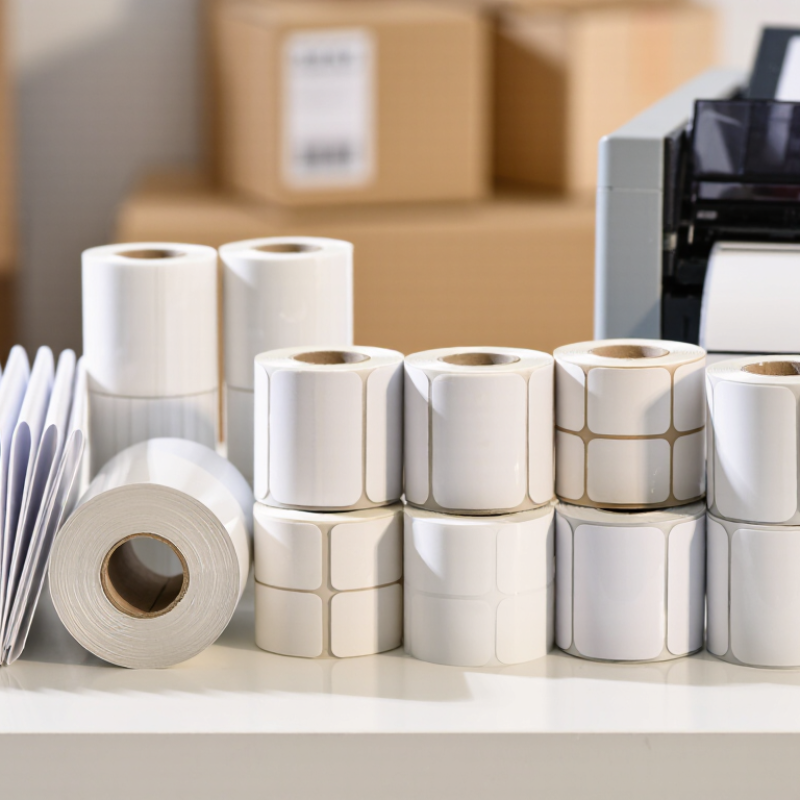
| 1 | Most versatile
Standard direct thermal paper labels | Routine parcel shipping, online orders, warehouses, and carrier-compliant address labels. | Usually a 4 x 6 inch sheet or roll; heat-sensitive paper with permanent pressure-sensitive adhesive; commonly available on 1-inch cores. | Suitable for normal indoor distribution and short-to-medium shipping cycles. Sensitive to prolonged heat, direct sunlight, friction, and some chemicals. | No ink or toner required; simple printer setup; low operating complexity; widely compatible with 4 x 6 thermal printers. | Printed images can fade or darken when exposed to heat, sunlight, plasticizers, or abrasion. | Confirm printer compatibility, roll orientation, core size, outside diameter, adhesive type, and the paper's heat and light resistance. |
| 2 | High-volume choice
Fanfold direct thermal labels | High-volume fulfillment stations, palletized case shipments, and operations that prefer easy stack feeding. | Connected 4 x 6 inch sheets folded into a stack, often with perforations between labels; supplied in counted packs. | The label face has similar thermal sensitivity to standard direct thermal paper. The folded stack is convenient but needs dry, clean storage. | Fast loading; compact storage; easy label counting; reduced roll changes; useful for batch printing. | Requires a printer designed for fanfold media or a suitable rear-feed path; folded edges can be damaged by poor handling. | Check feed-path clearance, stack height, perforation quality, print-side orientation, and whether the printer supports fanfold stock. |
| 3 | Longer-term use
High-sensitivity direct thermal labels | Fast printing, high-throughput parcel lines, and printers operated at lower heat or speed settings. | Heat-sensitive coated paper formulated to produce a readable image with less thermal energy than standard grades; available in 4 x 6 formats. | Print longevity still depends on the thermal coating. It is not automatically resistant to ultraviolet light, heat, or chemicals. | Can support faster throughput or lower print energy; often produces strong black contrast at suitable printer settings. | May cost more; excessive print-head heat can cause darkening or reduce image stability. | Request print samples at the intended speed and darkness; compare barcode contrast, smudge resistance, and storage-life requirements. |
| 4 | Outdoor handling
Weather-resistant synthetic thermal labels | Parcels exposed to rain, condensation, cold storage, rough handling, or short outdoor staging. | Synthetic face stock, commonly polypropylene or polyester, with a thermal-receptive surface and permanent adhesive. | Better resistance to moisture, tearing, and abrasion than ordinary paper. The thermal image may still be affected by ultraviolet exposure and extreme heat. | Does not readily absorb water; resists tearing; maintains label integrity on difficult delivery routes. | Higher material cost; some synthetic surfaces require compatible printer settings; adhesive performance varies by temperature. | Verify moisture, abrasion, temperature, and UV ratings; test adhesion on corrugated cartons, plastic totes, or poly mailers. |
| 5 | Easy removal
Removable direct thermal labels | Reusable bins, returnable transport packaging, rental equipment, and temporary shipment identification. | Direct thermal paper or synthetic face stock paired with a removable pressure-sensitive adhesive; commonly supplied in 4 x 6 rolls. | The adhesive is designed for clean or easier removal, but performance changes with surface energy, storage time, temperature, and humidity. | Helps reduce residue and surface damage; useful when labels must be removed after delivery or inspection. | May adhere less strongly to dusty, cold, rough, or highly textured surfaces; not ideal for every long-transit application. | Test removal after the planned dwell time; check residue, edge lift, carton fiber pull, and performance on the actual packaging material. |
| 6 | Secure attachment
Strong-adhesion direct thermal labels | Corrugated cartons, recycled cardboard, dusty warehouse surfaces, and shipments requiring firm label attachment. | Thermal-coated paper or synthetic stock with a higher-tack permanent adhesive; available in roll and fanfold 4 x 6 formats. | Good attachment depends on surface cleanliness, pressure, dwell time, and temperature. The paper face remains vulnerable to moisture unless protected. | Improves adhesion on challenging shipping surfaces; reduces edge lift and label loss during handling. | Can tear fibers or leave residue during removal; difficult to reposition once applied. | Review peel and shear data, application-temperature limits, carton compatibility, and whether the adhesive is approved for recycled corrugated surfaces. |
| 7 | Returns workflow
Two-per-sheet or integrated return labels | E-commerce orders that need a shipping label plus a return label, packing slip, or customer-facing document in one print cycle. | A 4 x 6 shipping label combined with one or more additional thermal sections, separated by perforations or release liners. | Performance depends on the paper and adhesive used in each section. Extra seams and perforations require careful handling. | Reduces manual insertion; supports organized returns; can combine multiple documents in one production step. | Uses more media per order; requires correct software templates and printer calibration; not suitable for every thermal printer path. | Confirm panel dimensions, perforation placement, software compatibility, liner direction, and whether all sections need permanent or removable adhesive. |
| 8 | Cold-chain use
Freezer- and cold-temperature adhesive labels | Refrigerated or frozen products, temperature-controlled logistics, and parcels applied in cold rooms. | Thermal paper or synthetic face stock paired with an adhesive formulated for low-temperature application or service. | Designed to retain adhesion under specified cold conditions. Condensation, frost, and wet surfaces can still reduce bonding. | Better initial tack and holding power in cold environments than general-purpose adhesives. | Usually more expensive; standard labels may fail if applied below their recommended temperature range. | Check minimum application temperature, service temperature, moisture resistance, freezer dwell time, and required surface preparation. |
| 9 | Sustainability option
Recycled-content thermal paper labels | Shipping programs seeking reduced virgin-fiber use while retaining conventional paper-label processing. | Thermal-coated paper containing a stated proportion of recycled fiber, typically with permanent or removable adhesive and a standard 4 x 6 format. | Suitable for ordinary dry shipping conditions. Moisture, heat, and image life depend on the coating and adhesive specification. | Can reduce virgin material consumption; generally compatible with standard direct thermal workflows. | Recycled content, surface smoothness, stiffness, and print performance vary by specification; not automatically recyclable with every package stream. | Request the verified recycled-content percentage, coating information, adhesive composition, disposal guidance, and barcode print samples. |
| 10 | Long-life identification
Top-coated synthetic thermal labels | High-abrasion logistics, reusable containers, long-retention records, and labels requiring stronger surface protection. | Polyester or polypropylene face stock with a thermal-receptive layer and a protective top coat; usually paired with permanent adhesive. | Offers strong tear and abrasion resistance. Depending on the top coat, it may provide improved resistance to moisture, oils, and handling wear. | Durable face material; suitable for demanding environments; supports clearer identification when paper labels would be damaged. | Higher cost; not all top coats are compatible with every print head or ribbon-free thermal process; disposal can be more complex than paper. | Confirm direct-thermal compatibility, chemical and abrasion resistance, adhesive temperature range, print-head requirements, and end-of-life handling. |