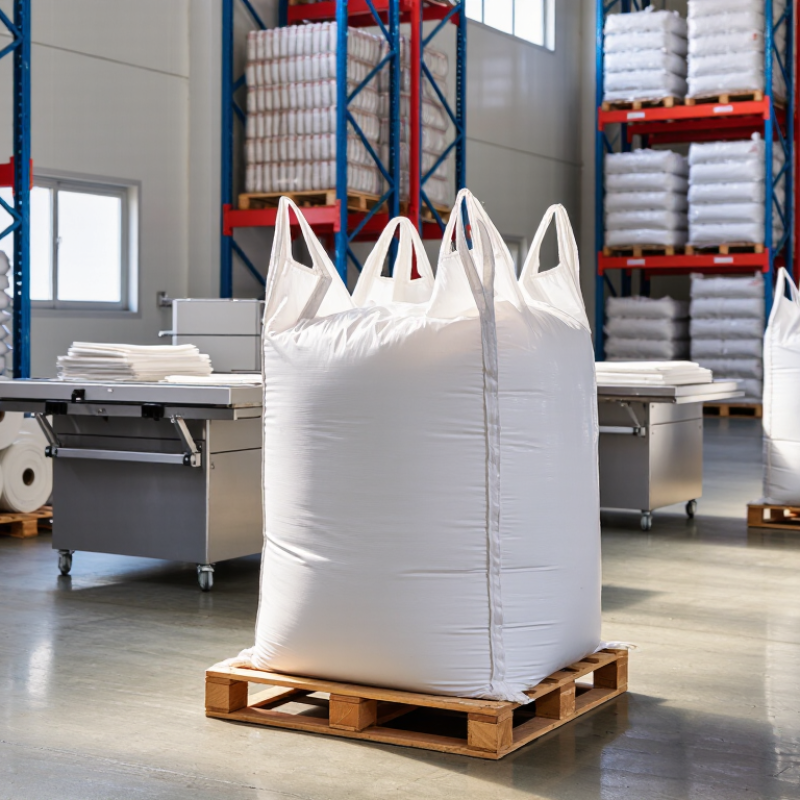
| Bag Size and Capacity | Common body dimensions include approximately 85 × 85 × 90 cm to 95 × 95 × 120 cm; working volume is often about 0.6–1.1 m³. | Required filled dimensions, target volume, pallet footprint, warehouse clearance, and transportation restrictions. | Ability to produce repeatable dimensions, maintain low tolerance, and adapt the pattern without reducing strength. | Dimensional inspection of first samples and production batches using calibrated measuring tools. |
| Safe Working Load (SWL) | Typical FIBC ratings range from 500 kg to 2,000 kg, depending on construction, material, and safety factor. | Maximum gross weight per bag, filling and discharge conditions, lifting method, and required safety factor. | Documented design calculations, suitable fabric weight, reliable seams, and batch-level load testing. | Top-lift or cyclic-load testing according to the applicable FIBC standard and purchase specification. |
| Safety Factor | Common designs use a 5:1 safety factor for many single-trip applications and a 6:1 factor for reusable applications, subject to the intended use and governing standard. | Whether the bag is single-trip or reusable, expected handling cycles, storage duration, and regulatory requirements. | Correct safety-factor selection, traceable test records, and clear labeling of reuse limitations. | Review of test certificates, construction drawings, and independent or witnessed load tests. |
| Baffle Construction | Cross-shaped internal baffles are commonly positioned on four sides to limit bulging and improve form stability. | Desired filled shape, baffle opening percentage, product flow requirements, and stacking arrangement. | Accurate baffle placement, secure attachment, unobstructed filling and discharge, and consistent finished geometry. | Visual inspection, internal measurement, filled-bag shape assessment, and stacking trial. |
| Fabric and Lamination | Woven polypropylene is standard; laminated fabric is selected when improved moisture or fine-powder containment is required. | Fabric weight, coating type, permeability, UV exposure, antistatic needs, and contact with the contents. | Stable raw-material quality, controlled coating thickness, low variation in tensile strength, and suitable cleanliness controls. | Fabric weight measurement, tensile testing, air-permeability testing, and coating inspection. |
| Filling Inlet | Common options include a standard top spout, wide-mouth inlet, or full-open top, selected according to filling equipment. | Inlet diameter, inlet length, closure method, filling speed, dust-control needs, and equipment interface. | Accurate dimensions, secure closures, compatibility with automated filling lines, and dust-minimizing design. | Fit test with the filling nozzle, closure inspection, and filled-bag leakage assessment. |
| Discharge Outlet | Typical discharge spout diameters are approximately 25–50 cm, depending on product flow and receiving equipment. | Outlet diameter, outlet length, closure type, liner connection, and required discharge rate. | Smooth discharge, reliable ties or closures, accurate placement, and no interference from internal baffles. | Timed discharge trial using the actual or representative product and receiving equipment. |
| Liner Requirement | Polyethylene liners are commonly used for fine powders, hygroscopic materials, or applications requiring additional product containment. | Liner thickness, film type, dimensions, attachment method, antistatic requirements, and food-contact status where applicable. | Correct liner fit, clean sealing, compatibility with the contents, and secure integration with the inlet and outlet. | Film thickness measurement, seal-strength test, leak test, and fit check inside the outer bag. |
| Electrostatic Control | Type A, B, C, and D FIBC configurations address different electrostatic risks; Type C bags require grounding during filling and discharge. | Material ignition sensitivity, operating environment, grounding procedures, flammable atmosphere classification, and handling equipment. | Correct electrostatic design, clear grounding instructions, controlled conductive components, and relevant testing capability. | Surface-resistance, continuity, breakdown, and electrostatic-performance tests conducted to the selected standard. |
| Product Compatibility | Dry powders, granules, flakes, and some agricultural or industrial materials can be packed in FIBC when the construction is properly selected. | Particle size, bulk density, moisture sensitivity, flowability, temperature, abrasiveness, and chemical characteristics. | Ability to recommend appropriate fabric, liner, coating, discharge design, and cleanliness level for the material. | Material compatibility review, trial filling, flow test, leakage test, and storage simulation. |
| Seam and Stitching Quality | Critical seams should use consistent stitch density, suitable thread, reinforced stress points, and clean seam finishing. | Seam type, stitch pattern, thread material, reinforcement requirements, and acceptable visual defects. | Controlled sewing parameters, operator inspection, low defect rates, and traceable corrective-action procedures. | Seam-strength testing, visual inspection, pull testing at lifting-loop attachments, and sample audits. |
| Lifting Loops | Four-loop construction is widely used; loop length and spacing must match the lifting frame or forklift attachment. | Lifting equipment, loop length, loop color coding, cross-corner or corner-loop design, and handling limitations. | Uniform loop height, reinforced attachment, correct load distribution, and compatibility with handling equipment. | Loop tensile test, filled-bag lifting trial, and inspection of attachment seams. |
| Cleanliness and Regulatory Use | Industrial, food-contact, pharmaceutical, and hazardous-material applications require different cleanliness and compliance controls. | Intended market, product-contact status, prohibited substances, hygiene level, documentation, and labeling requirements. | Defined cleaning procedures, controlled production areas where required, material declarations, and complete compliance documentation. | Visual cleanliness check, odor inspection, certificate review, migration testing, or laboratory analysis when required. |
| Printing and Identification | Printing may include handling symbols, batch fields, product information, hazard markings, and recycling instructions. | Artwork dimensions, print colors, variable data, barcode requirements, legal markings, and print durability. | Accurate artwork reproduction, legible variable information, ink adhesion, and controlled print registration. | Artwork proof approval, barcode scan test, rub test, and print-position inspection. |
| ODM Development Capability | A complete ODM process normally includes requirement review, technical drawing, prototype sampling, testing, revision, and production approval. | Expected development schedule, prototype quantity, approval milestones, intellectual-property ownership, and change-control process. | Engineering support, clear specifications, sample traceability, documented revisions, and production consistency after approval. | Review of drawings, sample reports, pilot-run results, inspection plans, and approved golden samples. |
| Quality and Delivery Control | The purchase specification should define inspection levels, sampling frequency, packaging method, delivery tolerance, and corrective-action timing. | Forecast volume, minimum order quantity, target lead time, shipment method, batch traceability, and acceptance criteria. | Stable capacity, documented quality system, reliable lead-time performance, and transparent nonconformance handling. | Pre-shipment inspection, production record review, lot sampling, delivery-performance tracking, and corrective-action verification. |