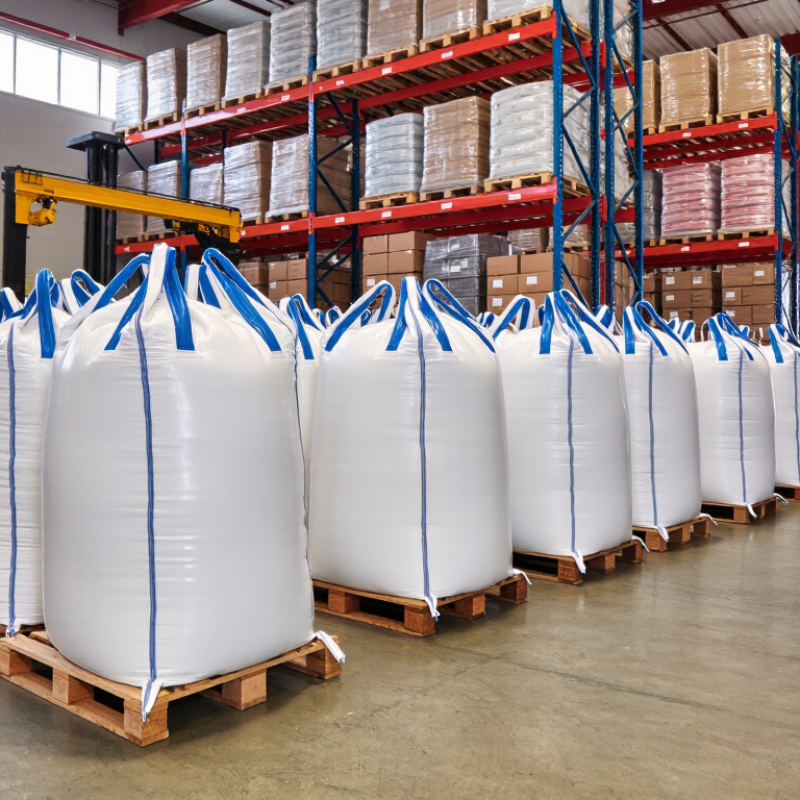
| Safe Working Load (SWL) | Rated SWL: 2,000 kg or higher | Confirm that the 2,000 kg rating applies to the complete bag assembly, including the body, lifting loops, seams, discharge spout, and top construction. | Prevents overloading during filling, lifting, storage, container loading, and port handling. |
| Safety Factor | Common one-trip benchmark: 5:1; reusable designs may require a different rating based on the intended number of cycles | Request the stated safety factor, test method, and certificate or test report. Do not assume a 5:1 rating means the bag can safely carry 10,000 kg in normal operation. | Shows the relationship between minimum breaking strength and the permitted working load under specified conditions. |
| Bag Dimensions | Typical 2-ton design range: approximately 90–100 cm wide × 90–100 cm long × 120–180 cm high | Verify filled dimensions, empty dimensions, tolerances, and whether the stated size is based on a square, circular, or baffle construction. | Ensures compatibility with pallets, warehouse racking, truck bodies, and standard shipping containers. |
| Approximate Volume | Often about 1.0–1.8 m³, depending on dimensions, product density, and filling height | Calculate volume from the actual bag dimensions and compare it with the bulk density of the cargo. Confirm the maximum fill level. | A 2-ton weight rating does not guarantee that the bag has enough volume for every low-density product. |
| Fabric Material | Woven polypropylene, normally uncoated or coated according to moisture and dust-control needs | Check polymer type, fabric construction, coating type, fabric weight, tensile strength, and lot traceability. Recycled content should be declared where applicable. | Polypropylene provides high strength-to-weight performance and is widely used for industrial bulk packaging. |
| Fabric Weight | Typical heavy-duty range: approximately 160–220 g/m², subject to design and safety testing | Verify the actual fabric weight and the test results for tensile strength, tear resistance, and seam performance. | Fabric weight alone does not determine safety, but unusually light fabric may require closer scrutiny for a 2-ton application. |
| Lifting Loops | Four-loop construction is common; loop SWL must support the complete 2,000 kg load with the specified lifting method | Check loop material, loop width, stitching pattern, lifting angle restrictions, and whether all loops must be used simultaneously. | Uneven lifting, forklift contact, or using fewer loops than specified can significantly increase stress on the bag. |
| Seam Strength | Seams should be tested as part of the complete bag assembly, not only as loose fabric samples | Request seam-strength results, sewing thread specifications, reinforcement details, and inspection records for critical load-bearing seams. | Seam failure is a common cause of loss of containment even when the fabric itself has adequate tensile strength. |
| Top Construction | Choose open top, duffle top, or filling spout according to the loading equipment and product requirements | Confirm inlet diameter, closure method, dust-tightness, dimensions, and compatibility with automated filling systems. | Correct top design reduces filling time, product leakage, dust release, and contamination risk. |
| Bottom Construction | Flat bottom for simple discharge; discharge spout for controlled emptying | Verify spout dimensions, closure type, discharge rate, residual-product control, and whether a safety flap is included. | Controlled discharge improves worker safety and helps prevent sudden movement or uncontrolled product release. |
| Liner Requirement | Use an inner liner when moisture protection, fine-powder retention, or higher product cleanliness is required | Check liner material, thickness, attachment method, heat-seal quality, and compatibility with the cargo. | A liner can reduce moisture ingress and leakage, but it does not replace the structural rating of the outer FIBC. |
| Moisture Protection | Coated fabric, liner, or both may be needed for moisture-sensitive cargo | Review coating coverage, water-resistance test results, liner closure, and storage instructions. Confirm whether the bag is only water-resistant or genuinely weatherproof. | Sea freight and port storage may expose packaging to condensation, rain, and changing humidity. |
| Antistatic Performance | For flammable powders, vapors, or hazardous-area filling, select the correct FIBC type and use qualified grounding procedures | Confirm the FIBC type, surface or volume resistivity data, grounding-point design, and applicable handling instructions. Obtain specialist approval for hazardous materials. | Static discharge can create an ignition hazard in certain atmospheres. Ordinary polypropylene bags are not automatically antistatic. |
| UV Resistance | UV-stabilized material is advisable when bags may be stored outdoors or exposed to sunlight | Check the stated outdoor exposure limit and UV-stabilizer information. Protect filled bags from prolonged direct sunlight whenever possible. | Ultraviolet exposure can reduce polypropylene strength over time, even when the bag initially meets its rated SWL. |
| Hazardous-Goods Compatibility | For regulated dangerous goods, use packaging tested and approved for the applicable substance and transport mode | Verify the UN packaging approval, performance level, filling instructions, labeling requirements, and current transport regulations for the cargo. | General-purpose FIBCs must not be treated as automatically approved for dangerous goods. |
| Standard Reference | ISO 21898 is a key reference for flexible intermediate bulk containers | Check the edition referenced by the supplier and whether the test scope covers the complete bag design and intended use. | A recognized standard provides a consistent framework for design, performance, testing, and marking. |
| Marking and Traceability | Each bag or production lot should be identifiable and clearly marked with handling information | Look for SWL, safety factor, bag type, tare or identification information, production lot, lifting instructions, and applicable warnings. | Traceability supports inspection, recall control, incident investigation, and correct handling across multiple countries. |
| Pre-Shipment Inspection | Inspect fabric, seams, loops, spouts, liners, dimensions, cleanliness, and markings before dispatch | Use a documented inspection checklist and retain photographs, sampling records, test reports, and packing-list details. | Early inspection reduces the risk of rejected cargo, contamination, rework, or unsafe handling at the destination. |
| Container Loading | Keep bags stable, evenly distributed, dry, and protected from sharp edges | Confirm stacking limits, pallet requirements, load-securing method, container cleanliness, and whether the filled bags may be stacked. | Transport vibration, sudden braking, and uneven stacking can damage otherwise compliant FIBCs. |
| Storage Conditions | Store in a clean, dry, ventilated area away from direct sunlight, moisture, chemicals, and heat sources | Review the supplier’s maximum storage period, temperature limits, packaging protection, and first-in-first-out procedure. | Storage conditions can affect fabric strength, cleanliness, moisture protection, and final lifting performance. |