| Manufacturing role | Direct manufacturers and packaging converters | Forming, molding, cutting, printing, or assembling containers and lids; some suppliers handle several production steps in-house. | Importers, food-service distributors, restaurant groups, and retailers | Confirm which processes are performed in-house, production capacity, quality-control procedures, and whether samples match production specifications. |
| Trading and export services | Exporters and sourcing intermediaries | Product sourcing, consolidated shipments, export documentation, and communication across multiple factories. | Smaller importers and buyers purchasing mixed product ranges | Identify the actual manufacturing site, clarify who controls quality, and verify responsibility for product documents and shipment claims. |
| Plastic materials | Rigid and flexible plastic-container suppliers | Common materials include polypropylene (PP) and polyethylene terephthalate (PET), used for different container and lid designs. | Takeaway operators, meal-prep businesses, supermarkets, and food processors | Check the exact resin and intended use. Microwave suitability depends on the specific product design and labeling; PET containers should not be assumed to be microwave-safe. |
| Paper and molded-fiber materials | Paperboard and molded-fiber packaging suppliers | Paper-based bowls, trays, and boxes; molded-fiber formats may use plant-fiber pulp. Barrier coatings or linings can affect end-of-life options. | Caterers, food-service distributors, takeaway businesses, and retailers | Ask about grease and moisture resistance, coating composition, temperature limits, and whether local recycling or composting facilities accept the finished item. |
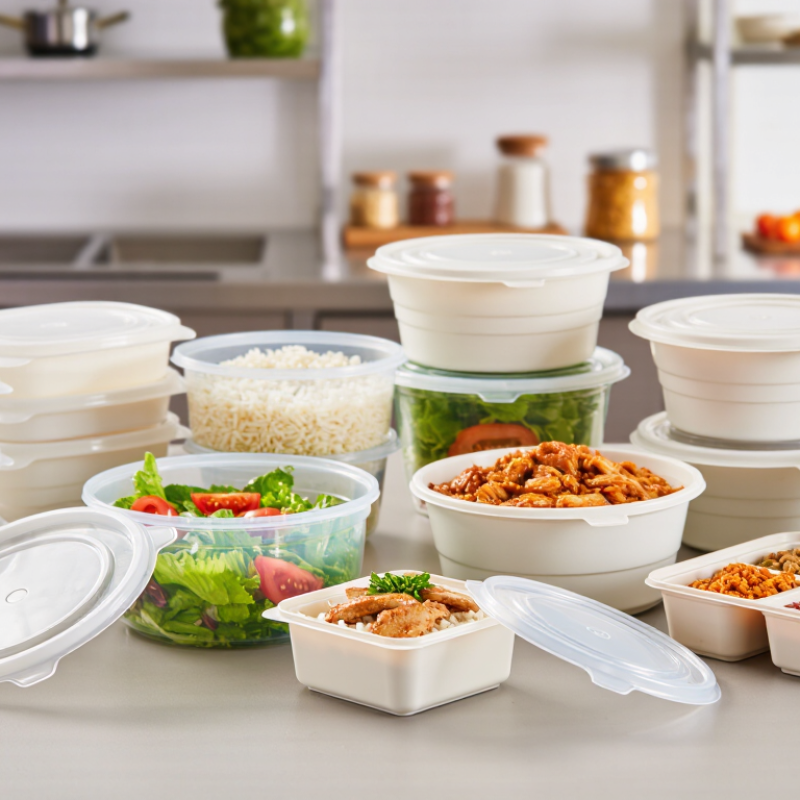
| Product format | Standard-stock and custom-format suppliers | Round or rectangular tubs, bowls, trays, hinged boxes, compartment containers, and matching lids. | Restaurants, meal-kit providers, central kitchens, and food retailers | Compare usable capacity, dimensions, lid fit, stacking stability, leak resistance, and compatibility with filling or sealing equipment. |
| Customization and order model | Private-label and made-to-order suppliers | Custom dimensions, colors, printing, packaging, or tooling may be available; requirements vary by material and production method. | Brands, wholesalers, and buyers with established packaging specifications | Request written details for minimum order quantity, tooling charges, sample approval, lead time, artwork proofing, and ownership of custom molds. |
| Sales channel | Factory-direct, export, and domestic distribution channels | Direct production orders, export orders, or smaller-volume purchases through packaging distributors. | Importers, regional wholesalers, food-service operators, and local retailers | Compare total landed cost, order quantity, payment terms, delivery schedule, freight arrangements, and after-sales support—not just unit price. |
| Food-contact documentation | Suppliers serving regulated destination markets | Product specifications, material declarations, and test documentation relevant to the intended food-contact use and destination market. | Importers, retailers, food manufacturers, and institutional buyers | Match documents to the exact product, material, color, and intended use. Confirm applicable destination-market requirements with the importer or qualified compliance professional. |
| Quality and logistics | Suppliers with export packing and shipment coordination | Carton packing, palletization, production inspection, and shipment coordination, depending on the supplier’s capabilities. | Overseas distributors and high-volume buyers | Agree on inspection criteria, tolerances, carton count, protective packing, shipping terms, and procedures for handling defects or shortages. |