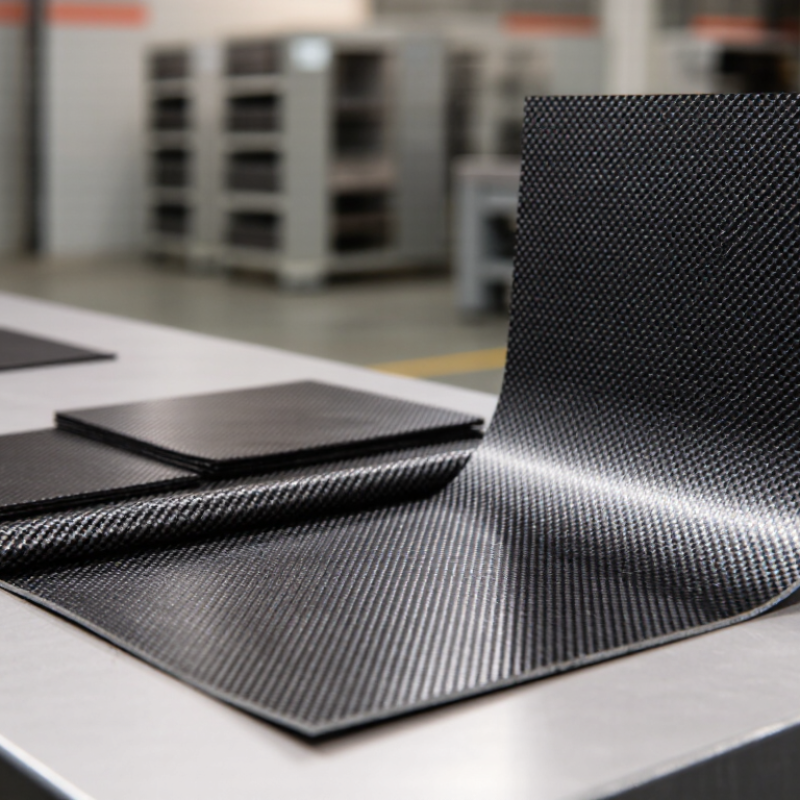
| Material and resin system | Confirm whether the sheet uses carbon-fiber reinforcement with epoxy, vinyl ester, or another resin system. Resin choice affects processing, temperature capability, chemical resistance, and intended use. | What fiber and resin systems are available? Can you provide the material specification and technical data for the proposed sheet? | Compare documented properties and service conditions against the requirements of the application. Do not rely on a generic “carbon fiber” description alone. |
| Fiber format and layup | Identify whether reinforcement is woven fabric, unidirectional material, or another construction. Layup direction and sequence influence stiffness and strength in different directions. | Can you provide the ply orientation, layup schedule, and construction details for the quoted product? | Check that the documented layup matches the expected loading directions and design requirements. |
| Manufacturing process | Ask how the sheet is made, such as press molding, autoclave processing of prepreg, or another controlled process. The process can affect consistency, surface finish, and void content. | Which production process is used, and what in-process controls are recorded for each production lot? | Request process descriptions and sample inspection records relevant to the specific product and production route. |
| Thickness and dimensions | Specify nominal thickness, length, width, flatness, and any required dimensional tolerances. Tolerances should be agreed for the actual product rather than assumed to be universal. | What tolerances can you guarantee for the requested sheet size and thickness? How are dimensions measured and recorded? | Compare the written quotation and drawing against the required dimensions; request a dimensional inspection report where needed. |
| Mechanical properties | Review relevant tensile, flexural, and interlaminar properties. Values depend on the fiber, resin, layup, thickness, and test method. | Can you provide test data for the same material construction and a clearly stated test method? | Check whether results identify the specimen direction, conditioning, test standard, and product construction. Avoid comparing results from unlike layups or methods. |
| Test methods and verification | Recognized methods include ASTM D3039 for tensile properties of polymer-matrix composites, ASTM D7264 for flexural properties, and ASTM D2344 for short-beam strength. | Which tests are performed in-house or by an independent laboratory, and are the reports traceable to the supplied material? | Review complete reports, including method, specimen details, results, and laboratory identification. Select tests based on the application. |
| Quality control and traceability | Look for documented incoming-material checks, production controls, final inspection, nonconformance handling, and lot identification. | Can each shipment be linked to a production lot and inspection record? What quality-management documentation is available? | Review sample records and confirm that certificates and inspection documents identify the same product and lot being quoted. |
| Surface finish and machining | Define the required finish, protective film or coating, edge condition, hole pattern, and any cutting or machining work. Machining composite sheets may require suitable tooling and dust controls. | Can you supply cut-to-size or machined parts? How are edges protected and composite dust controlled during processing? | Evaluate a production-representative sample for finish, edge quality, dimensional accuracy, and compatibility with the intended assembly. |
| Application suitability | Consider operating temperature, loading direction, moisture or chemical exposure, impact, electrical requirements, and applicable product regulations. | What application data do you need to recommend a sheet, and what limitations should be considered? | Have the material and design reviewed against the actual service conditions; a material data sheet alone does not qualify a finished design. |
| Samples and production consistency | Check whether samples represent the quoted construction and whether repeat orders can be supplied to the same agreed specification. | Can you provide a sample and confirm how changes to materials, process, or construction are communicated? | Approve a written specification and compare the approved sample with production inspection records before placing repeat orders. |
| Packaging and shipping | Sheets should be protected against scratches, bending, moisture, and transit damage. Packaging requirements depend on sheet size, finish, and route. | How are sheets supported and protected for export shipment? Can packaging be tailored to the dimensions and surface requirements? | Agree on packaging details in writing and inspect incoming goods for transit damage and dimensional changes. |
| Quotation and commercial terms | Compare material specification, quantity, minimum order requirements, lead time, sample costs, payment terms, and delivery terms—not price alone. | Does the quotation identify the exact construction, tolerances, inspection documents, packaging, and delivery terms? | Use a common specification when comparing quotations so that offers cover equivalent materials and services. |