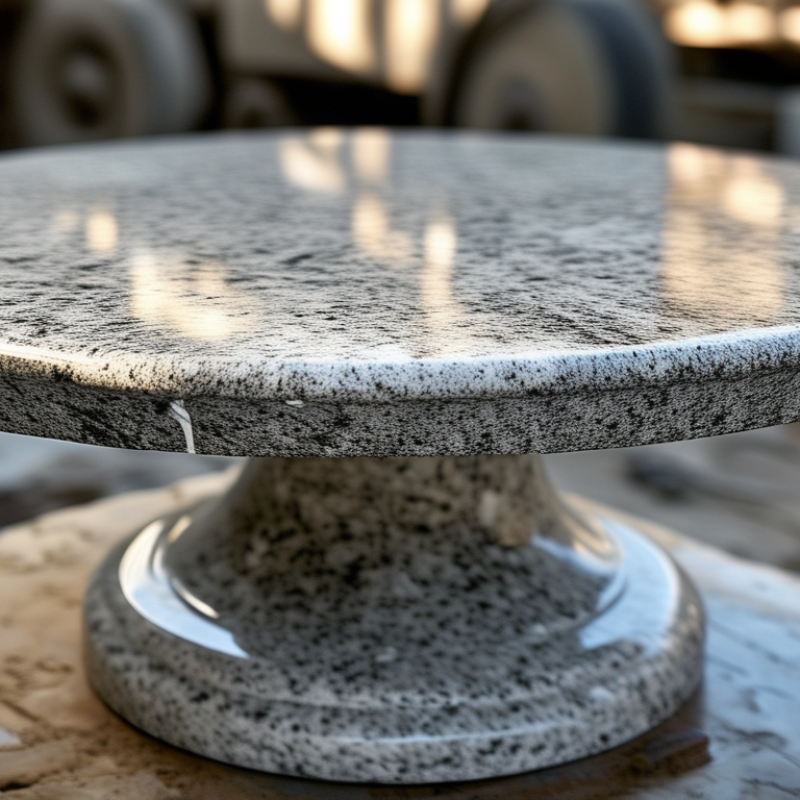
| Granite Composition | Natural igneous stone, commonly containing quartz, feldspar, and mica | Mineral composition influences hardness, appearance, density, and long-term wear resistance. | Request the stone specification and confirm that the product is solid granite rather than a thin decorative layer over another material. |
| Density | Approximately 2.63–2.75 g/cm³, or 2,630–2,750 kg/m³ | Higher density generally provides substantial mass and helps the base resist movement when used with outdoor furniture. | Compare the stated weight with the base dimensions. An unusually light product may contain a hollow section or a non-granite core. |
| Hardness | Typically about 6–7 on the Mohs mineral hardness scale | Hard stone is better suited to resisting ordinary scratching and surface wear. | Look for a technical specification or material certificate. Avoid relying only on color or polished appearance. |
| Water Absorption | Often below 1% for dense granite, but the exact value varies by stone | Lower absorption can reduce staining, moisture-related discoloration, and freeze–thaw vulnerability. | Ask for the tested water-absorption value. For outdoor use in freezing climates, confirm that the stone is suitable for freeze–thaw exposure. |
| Compressive Strength | Common granite values are broadly around 100–250 MPa; the tested grade should be verified | Strength helps the stone support loads without crushing, although the base design and mounting hardware are equally important. | Request test data based on a recognized stone-testing standard and check whether it applies to the actual granite type. |
| Base Weight | Common residential bases range from approximately 20–50 kg, depending on design and application | More mass usually improves stability, but weight alone does not determine safe performance in strong wind. | Match the weight to the furniture, pole, canopy, surface, and local wind conditions. Follow the product's stated maximum use limits. |
| Dimensional Tolerance | Uniform thickness and a level underside are essential; the permitted tolerance should be stated by the manufacturer | Uneven dimensions can cause rocking, uneven loading, or poor contact with the ground. | Place the base on a flat surface and check for rocking. Measure thickness and inspect the underside for warping or deep depressions. |
| Edge and Corner Finish | Smooth, eased, or rounded edges are preferable to sharp untreated edges | Finished edges reduce chipping risk and make handling safer. | Inspect corners, drilled openings, and polished edges for cracks, chips, resin-filled defects, or exposed weak veins. |
| Surface Finish | Polished, honed, flamed, or textured finishes are common | Polished surfaces offer a smooth appearance; honed or textured finishes can provide a less glossy, more slip-resistant feel. | Choose a finish appropriate to the environment. For wet outdoor areas, avoid relying on a highly polished surface where slipping may be possible. |
| Mounting Hardware | Hardware should be corrosion-resistant and correctly sized for the pole or furniture attachment | Weak or poorly fitting hardware can fail even when the granite itself is strong. | Check thread size, sleeve fit, fastener material, washer support, and whether replacement hardware is available. |
| Drainage and Moisture Control | Outdoor designs should avoid water-trapping recesses and allow moisture to drain | Standing water can stain stone, corrode hardware, and contribute to deterioration during freeze–thaw cycles. | Inspect holes, joints, and the underside for drainage paths. Do not permanently seal areas that are designed to drain. |
| Sealing | A penetrating stone sealer may reduce staining, but it does not make granite completely waterproof | Sealing can simplify maintenance, especially in areas exposed to food, oil, soil, or repeated moisture. | Confirm whether the base is pre-sealed, identify the recommended sealer, and follow the stated reapplication interval. |
| Climate Suitability | Outdoor use requires resistance to moisture, temperature changes, UV exposure, and freeze–thaw conditions where applicable | Climate-related stress can affect stone, finishes, adhesives, and metal components differently. | Ask for outdoor-use approval and freeze–thaw information if the base will remain outside year-round. |
| Safety and Stability | The complete system must be evaluated: base mass, footprint, pole height, canopy size, surface friction, and wind exposure | A heavy granite base can still overturn if the supported structure creates excessive leverage. | Use the manufacturer's maximum supported size and wind guidance. Secure or remove umbrellas and canopies during severe weather. |
| Maintenance | Clean with water and a pH-neutral stone cleaner; avoid harsh acids and abrasive powders | Acidic and abrasive cleaners can dull finishes, damage sealers, or etch mineral surfaces. | Follow the care instructions and test any cleaning product on a small, inconspicuous area first. |
| Documentation | A premium product should provide material, dimensions, weight, hardware, care, and use-limit information | Clear documentation makes it easier to compare products and verify suitability without relying on appearance alone. | Prefer products with written specifications, warranty terms, installation instructions, and replacement-part information. |